Air Gradia
Station ElevenAir Gradia is the airline associated with Flight 452, whose diversion to Severn City Airport turns a routine journey into a prolonged encounter with the collapse of ordinary air travel. The novel gives little information about the company beyond this flight and its employees; instead, its significance emerges through the contrast between the mobility Air Gradia’s aircraft once enabled and the sealed, motionless plane that remains at the airport.
Identity and Place in the Novel
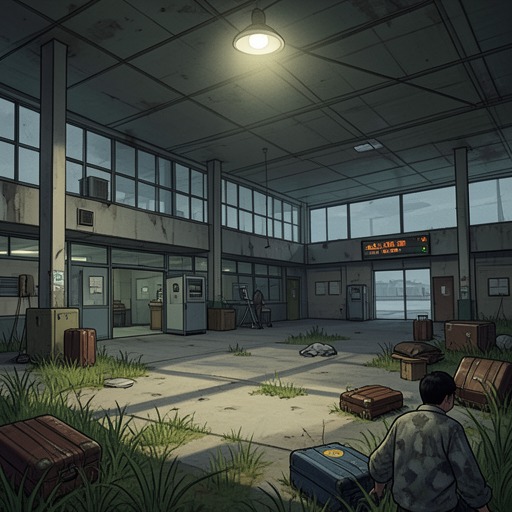
Air Gradia enters the story as a commercial airline operating during the early spread of the Georgia Flu pandemic. The evidence centers not on the company’s history or corporate structure but on a single flight and the people caught up in its disruption. Its name remains visible at Severn City Airport even as the systems that made airline travel dependable are failing: the arrival display still announces Flight 452 while an agent at the ticket counter is in tears and the radio carries news of quarantine.
This limited portrayal makes Air Gradia a concrete part of the novel’s account of interrupted infrastructure. Before the collapse, air travel could move passengers between cities in hours. During the crisis, a flight can still arrive, but arrival no longer guarantees onward travel, access to functioning airport services, or a way home. The company is therefore associated with the transition from ordinary transport to involuntary immobility, rather than with a fully described corporate response.
Flight 452 and the Diversion
Clark Thompson boards a morning flight from John F. Kennedy International Airport to Toronto, hoping to arrive before a predicted snowstorm disrupts the airports. The pandemic is already spreading through the city, but Clark is unaware of the social-media rumors about its arrival. By chance, he avoids close contact with infected people in the terminal and boards one of the last planes to leave the airport: the twenty-seventh-to-last departure.
Also aboard are Elizabeth Colton and her son, Tyler Leander. Clark recognizes them only after they are boarding. He had told Elizabeth about his planned flight, and she had said she would try to join it; the meeting is therefore a coincidence shaped by an earlier conversation, not a wholly unexpected encounter. Elizabeth and Tyler sit in First Class, while Clark travels in Economy. They exchange greetings, then do not speak again until the plane is diverted to a Michigan airport Clark does not know. The passengers disembark confused and disoriented at Severn City Airport.
The diversion brings together several consequences of the crisis. The passengers have reached an airport, but roads are impassable with abandoned cars, and there are no functioning trains, buses, or commercial flights to carry them onward. Some leave on foot toward Severn City; others return after discovering that ground transport is unavailable. Clark decides to stay. The arrival display continues to show Flight 452 even as the airline’s own agent receives the quarantine news, placing the familiar language of scheduled travel beside the breakdown of the journey it was meant to describe.
Quarantine and the Grounded Aircraft
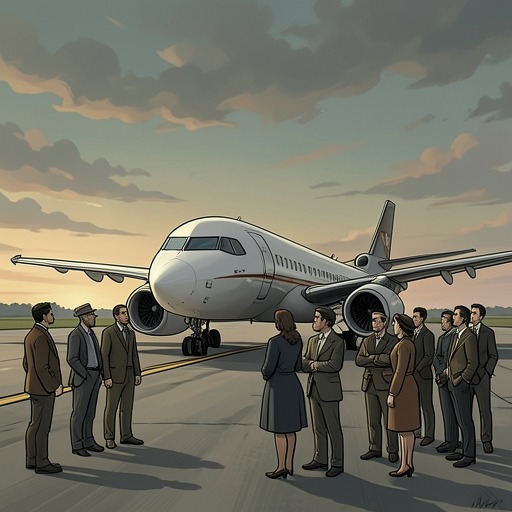
The Air Gradia jet does not release anyone else. It remains on the tarmac, and the people sheltering in the airport do not see anyone emerge from it. As the crisis deepens, the aircraft becomes a persistent presence at the edge of the community’s attention. Clark understands the danger of opening it: he later tries not to think about the decision to keep the jet sealed rather than expose a crowded airport to a potentially fatal contagion, or about what enforcing that decision may have entailed. The account makes the quarantine a matter of collective protection under extreme uncertainty, without detailing the decision-makers or the procedure used to enforce it.
The passage of time changes the plane’s meaning without changing its physical situation. After a snowstorm, the runway has no de-icing machines, tire tracks, or ground workers; Flight 452 remains alone on the tarmac. The aircraft is no longer simply delayed transport. It marks a boundary that the airport community treats as dangerous and, in time, nearly unspeakable. Clark tries not to look toward it and sometimes almost convinces himself that it is empty like the other planes. That effort to avoid thinking about it underscores the burden of maintaining daily life alongside an unresolved threat.
The Plane’s Afterlife and Significance
Months later, the Air Gradia jet is still strictly off-limits. Clark sees a child near it and discovers Tyler standing by its nose, reading aloud from a paperback. The children in the airport have told ghost stories about the plane, and Tyler’s presence there brings the forbidden aircraft into contact with the imaginative life of the settlement. The episode does not remove the quarantine or explain what happened aboard; it shows instead how the sealed plane persists in memory and speculation, even for children growing up within the airport community.
Flight 452 also belongs to a wider transformation in the novel’s treatment of aviation. Air travel once offered views of towns as points of light from high above; after the collapse, airplanes are left dormant on runways and in hangars, their uses reduced to what local circumstances permit. That broader fate should not be confused with a detailed account of Air Gradia’s later operations: the narrative does not establish what became of the company as an institution. Through its one stranded flight, however, Air Gradia supplies a sharply specific image of a world in which movement survives briefly after the systems supporting it have failed. The journey begins as a scheduled trip to Toronto, becomes an involuntary diversion, and ends in a long stillness around an aircraft that the survivors cannot safely treat as either ordinary transport or an empty shell.